
Setting an example
An open letter to Cycling UK

Dear Cycling UK,
I’m writing to ask that you reconsider your exclusion of trans women from the ‘100 Women In Cycling’ list that you published last week.
I’d also like to request that you put some meaningful, material work into making cycling a more supportive place for trans women – and trans people in general – as you do for other marginalised groups. I am sure that the majority of your members will agree that this is very important.
I’m genuinely a bit heartbroken that an organisation I care so much about has taken this step, which will unquestionably affect trans people’s access to the cycling community, at a time when they need it more than ever. I worry that this exclusion will be the thin end of the wedge, and that those who wish to exclude trans women from women’s spaces will seek to extend it to the many groups with whom Cycling UK are affiliated.
As you will know from your work over the past few decades, there is so much more to riding a bike than just the sporting aspect. It improves our physical and mental health. It gives us mobility and saves us money. It helps us build a deeper relationship with the world around us. It introduces us to friends and communities we might not otherwise have encountered. Last week (after speaking at your Scottish Annual Gathering) I wrote about the endless directions in which cycling enables us to grow.
Trans women are just as much in need of all this as the rest of us – in fact, probably more so, because right now life is getting harder for trans people in the UK. As no doubt you know, the recent guidance given by the Equality and Human Rights Commission has made it more difficult for them to access public spaces. A YouGov poll, published last week, shows that 65% of trans people have experienced verbal abuse in public spaces, and 24% have suffered physical violence.
As I’m sure you’re aware, transphobia and gender-policing have become increasingly prevalent in recent years. I am a cisgender woman with short hair and an appearance that some people consider masculine, and now every time I walk into a changing room I worry someone is going to confront me. I can only imagine how much worse this would be if I were trans, and how afraid many trans people must be to leave their houses, use public facilities, and join social groups.
We are urgently in need of groups and organisations who will stand up and say “trans people are welcome: you belong here, we actively want you with us, and we will do whatever we need to do to ensure your safety.” And it seems obvious to me that Cycling UK should be one of those groups.
British Cycling banned trans women from competing in the female category two years ago. (Against the wishes of many of its constituents, as this statement from several London cycling clubs shows.) But Cycling UK’s work is not about competition – it’s about community. It’s about riding together, and sharing all the life-changing benefits that cycling has to offer.
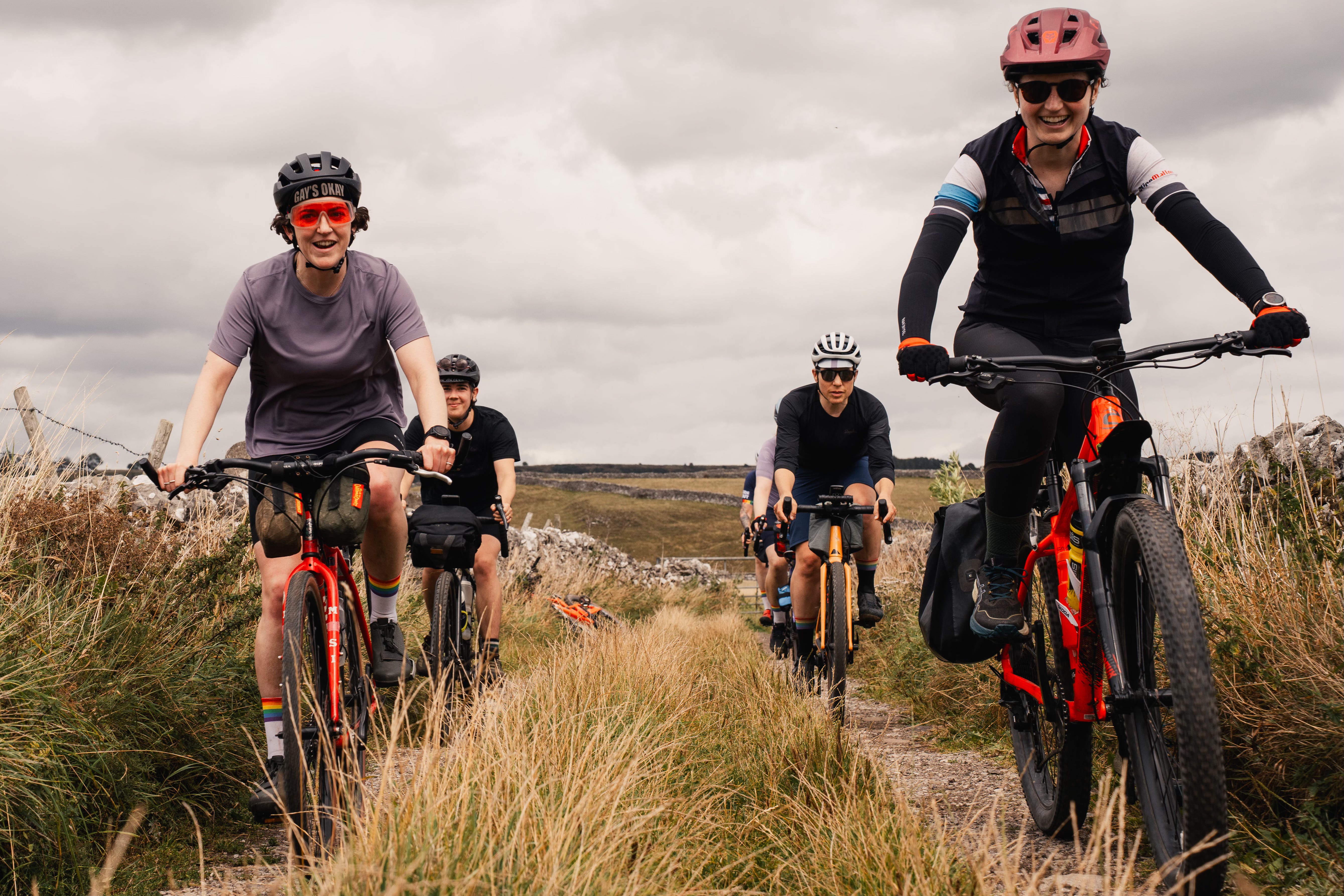
Cycling has been a central part of my life for two decades now, and over that time it has given me countless friendships with people I might not otherwise have encountered. I have ridden with folks who have very different backgrounds and perspectives from my own, and our hours in the saddle (and at the café stop) have given us the opportunity to reconcile our differences and rejoice in our similarities.
To offer an example you perhaps might not expect, I often quip that cycling is the only reason I have anything to do with middle-aged men. But perhaps I shouldn’t joke about this. As a gay woman, I could very easily have ended up leading a life in which men barely existed, and as a result have reduced them to a collection of harmful stereotypes. But, thanks to cycling, I have spent thousands of miles riding alongside them. We’ve had deep and meaningful conversations, and shared what is going on in our lives. I’ve heard about their joys and sorrows and doubts and fears, and they have listened to mine. Although I admittedly sometimes roll my eyes at their behaviour, I am also in no doubt that middle-aged men are real, complex people, with whom I have far more common ground than I might otherwise have thought.
We owe trans people this same courtesy. In a world where they are increasingly slandered and stereotyped, it is vital that we take every opportunity we can to ride alongside each other. To enjoy the many things we have in common, and to gently explore our differences.
Excluding trans women from the cycling community will only serve to widen the divide, rather than repairing it. It is only a small minority of people who feel threatened by their presence, and I strongly suspect that many of them will never have got to know someone who is trans, spent time with them and realised that they are a person like any other – that, as with so many other minority characteristics, being trans is just one small part of who they are.
If trans women are excluded from cycling groups, whether explicitly or implicitly, more and more people will only learn about them through scaremongering and stereotypes – much as happened with gay people within living memory.
I grew up in the 80s and 90s, when society was far more homophobic, and Section 28 effectively prevented any discussion of LGBTQ+ matters in schools. Nowadays, gay, lesbian and bisexual people are part of everyday life. It’s common to have a gay colleague, to run into a two-mum family at the school gates, and to hear a man talking about his husband. But back then, very few of us felt it safe to come out, and gay people were told “we don’t care what you do, but we’d prefer it if you do it behind closed doors.” Which meant that they were effectively excluded from society, and all of the harmful stereotypes could flourish.
I was told that lesbians were dangerous in much the same way that trans women are described today: we were considered predatory, exhibitionist, repulsive and ridiculous. Unwomanly. And I had no access to any role models who could show me otherwise. There were probably more gay people in Mid Wales in the 90s than I realised. But almost everyone was closeted back then, so it was impossible for me to know that you could be gay, and also be a normal(ish) person, who led an ordinary life.
This did me a lot of harm. Inevitably I ended up internalising some of the homophobia that swirled around me. And when things began to improve in the 2000s, and I started to come out to my friends and family, I was met with all sorts of residual prejudice. I can’t really blame people for that – they had been exposed to exactly the same stereotypes as I had.
I can see the same thing happening to trans women today, and I find it heart-breaking. We desperately need to preserve those spaces where all of us can safely come together, in person, and get to know each other. Cycling is already a great gatherer of people, and thus I think Cycling UK is perfectly placed to lead the way on this.
In your eligibility statement for ‘100 Women in Cycling’, you say that:
Cycling UK is still absolutely dedicated to making cycling welcoming for everyone. This change to our awards doesn’t alter our strong commitment to supporting all cyclists, including transgender and non-binary people. We truly believe cycling is for all, and we’ll keep working towards that goal.
But these feel like empty words, given that you have just taken a step to make a marginalised group feel more marginalised. Although you state that Cycling UK wants to make cycling “welcoming for everyone”, your actions say otherwise, and you have done nothing to address the fact that this move will make trans people more hesitant to cycle with others, and embolden those who wish to exclude them.
I know some people will argue that no one is preventing trans women from joining mixed groups, or racing in British Cycling’s ‘open’ category. But this is disingenuous. Even if trans people are welcome in theory, this recent statement is just the latest of countless indications that is acceptable to question their presence, that they’re only provisionally included, that some people don’t want them around.
Plus, a lot of people (myself included) find it daunting to join a group where they will be a visible minority or, worse still, the only woman or person of colour, or the largest, or the oldest. Let’s not pretend that the psychological barriers aren’t the hardest to overcome. Excluding trans women from women-only spaces, and insisting that they content themselves with mixed groups, will mean that fewer of them ride with us. Some may continue to cycle on their own; others will give up entirely. Either way they will be deprived of many of the physical, mental and social benefits that the rest of us enjoy.
Cycling UK has done a lot of very good work to make sure that cycling is accessible to minorities and marginalised groups – to those for whom there are many more hurdles, practical and psychological, even to get to the start line. By telling trans women that they are not included in ‘100 Women In Cycling’, you have created yet another hurdle to their participation.
Regardless of whether you change the parameters of ‘100 Women In Cycling’ (though I very much hope you will), I would like to hear what Cycling UK plans to do – practically and rhetorically – to ensure that trans people are welcomed, protected, and as able to access all the benefits of cycling as much as the rest of us. It is undeniable that they are currently at a disadvantage, and it is Cycling UK’s responsibility to address this.
At the moment, it seems to be the fashion to turf trans women out of women’s spaces, and then issue a flimsy soundbite about the importance of inclusion, without making the slightest concession to accommodate them anywhere else.
We need more than empty statements. And Cycling UK, with their long tradition of making cycling accessible to all, are the perfect organisation to set an example.
If you genuinely mean what you say about wanting to support all cyclists, then it is essential to acknowledge the specific challenges that different groups face, and then put concrete plans in place to address them. I suspect that trans people, and the many groups who wish to ride with them, would welcome:
a good-faith consultation into what needs to be done to minimise the barriers they face,
a strong statement, acknowledging the legal and social challenges that might prevent trans women from accessing sport and leisure groups, and explicitly affirming your commitment to finding solutions,
guidance for Cycling UK affiliated groups on how they can welcome and support trans riders,
a campaign to encourage more trans people to take up cycling.
Someone has to set an example of how trans women can be included, fairly and equitably, and it seems obvious to me that it should be Cycling UK.
Trans people have always been part of my cycling life. I have ridden with them, raced against them, volunteered alongside them, and spent hours hanging around drinking coffee. I have benefited from their support, wisdom and expertise. When I first got into cycling, back in 2006, one of the most instrumental people in showing me the ropes was a trans woman. Without her, I might not have become the cyclist I am today.
I would like to tell you about some of the incredible trans riders, mechanics, coaches, journalists, frame builders and ride leaders that I have had the privilege of crossing paths with over the last two decades. But I won’t do so here, for fear of drawing attention to people who right now would rather stay out of the spotlight.
The wonderful, diverse, supportive community that exists around cycling belongs to trans people just as it belongs to the rest of us. They have always been here. They have contributed as much as any of us, and the effort and energy they have put in deserve to be recognised. And those who have not yet discovered the magic of cycling should be given every opportunity to do so. As you and I already know, it will change their lives for the better.
Regrettably, those who wish to restrict membership of their cycling group to people assigned female at birth (i.e. cisgender women and trans men) can probably now proceed without legal challenge. So it falls to the rest of us to redress this balance, and to demonstrate to trans people, with words and with deeds, that the majority of us appreciate their contributions, care about their safety and wellbeing, and want them to ride alongside us.
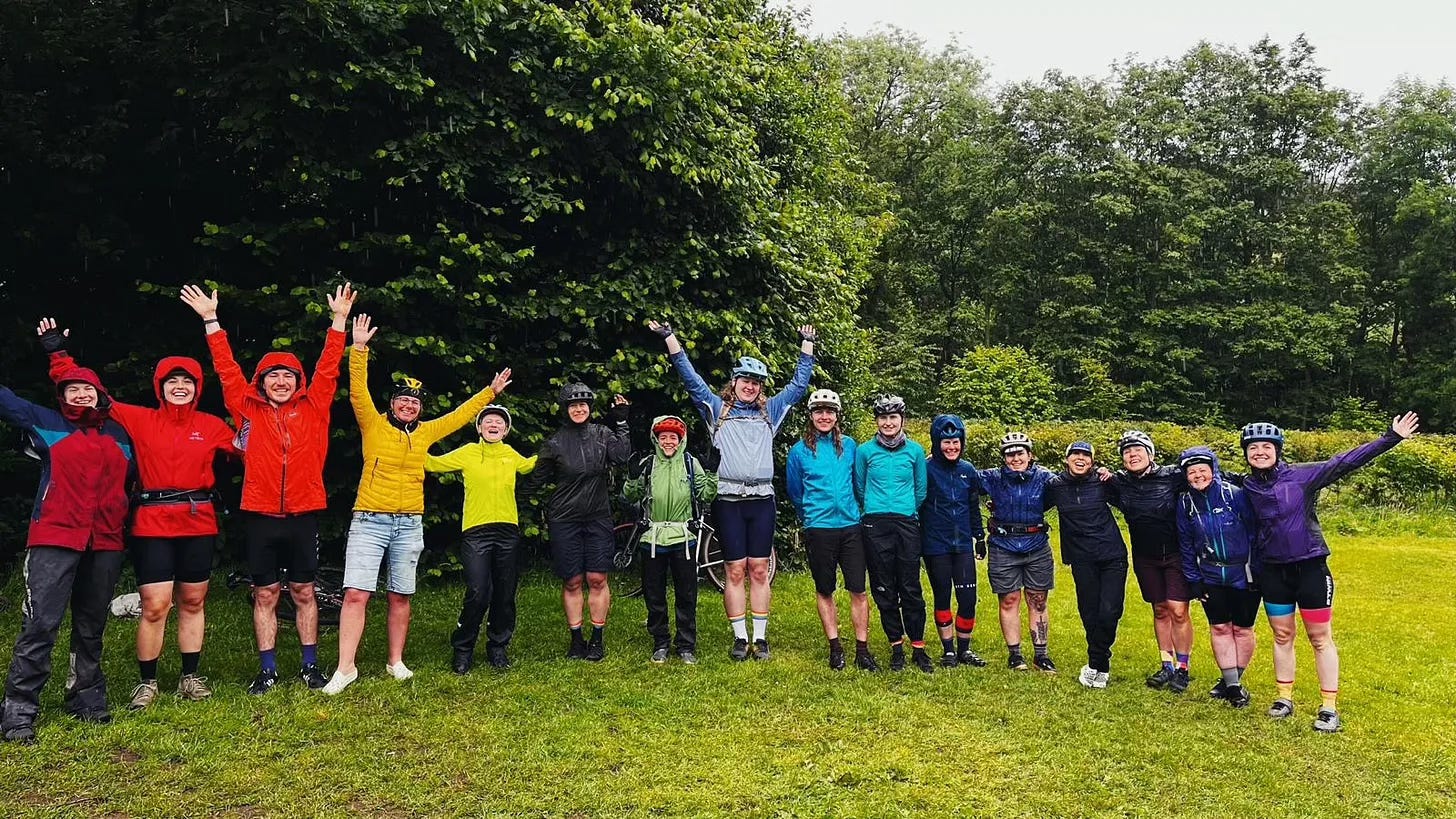
Trans women are warmly invited to join any ride, group or event for which I am responsible. This has always been the case, and it always will be.
I look forward to hearing a similar statement from Cycling UK.
Emily Chappell
(One of the original 100 Women in Cycling)
100% agree and cycling UK really need to respond, I have messaged similar. Ta
Absolutely.