
Somewhere to go
On the vital importance of public toilets

When I was a courier I had a detailed map of London in my head, and was always adding to it. As you’d expect, it included the locations of our regular clients, the entrances to their loading bays (which would often be on a completely different street from the main entrance), the routes between them, and the best spot to lock up my bike when I got there. Over time, I added shortcuts that helped me avoid main roads and busy junction, and all the different turns to get me through the intricate one-way systems of Soho and Mayfair. I memorised minor hazards like potholes, drain covers, and that very slightly raised kerb stone on the junction between Euston Road and Fitzroy Street, which would tip you over if your wheel caught it at the wrong angle.
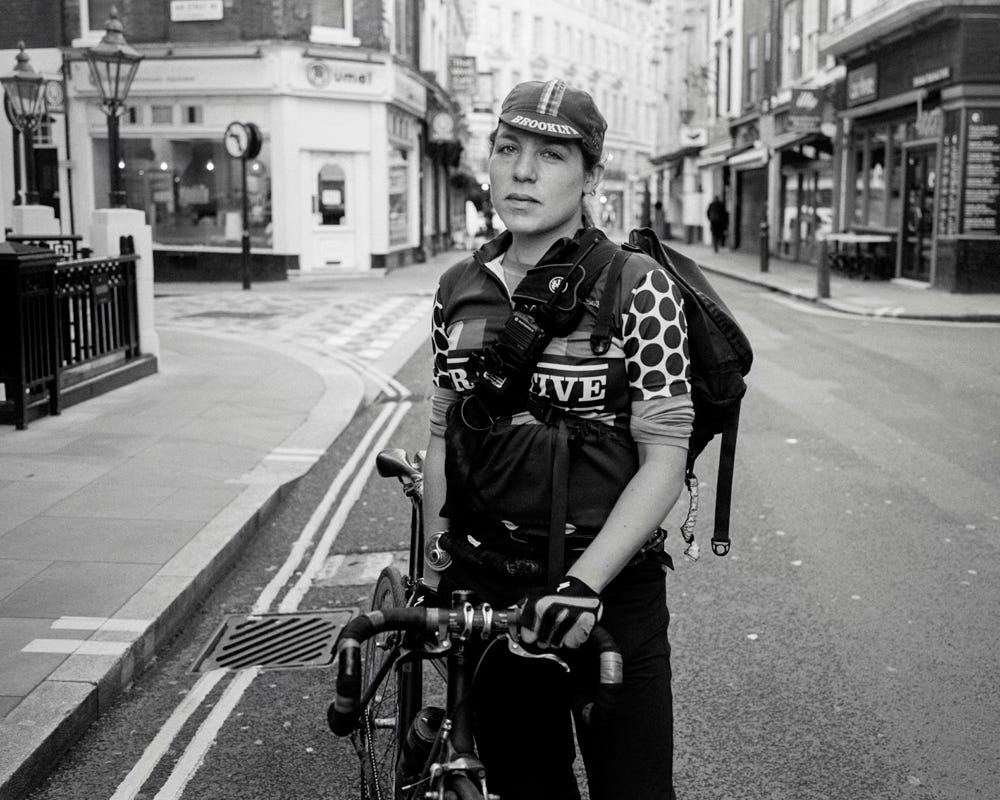
But there was much more to this mental map than just routes and locations, because as a courier my entire working day was spent out in the streets – most of us didn’t have any sort of base or common room to return to. So I also got to know the places where I could sit and wait in between jobs: the parks where there would always be a free bench, the café on Wimpole Street where you could get a cup of tea for 65p (this was back in 2008), the vents on Wood Street EC1 and outside the Sainsbury’s on Fetter Lane, which blew warm air on cold days. I’m sure every courier had their own mental list of places to stand when it was raining – sheltered doorways, underpasses, bandstands, and covered arcades like the ones in Covent Garden. No matter where you found yourself in the West End or the City, if you called in empty and were told to stand by, once you’d been on the road a little while, you’d know exactly where to go and wait for the next job.
If you were in a sociable mood you might gravitate to 65 Gresham Street, where the couriers would sit together on the low wall beside the building, or to the junction of Broadwick and Poland in Soho, popularly known as Creative Corner (after the company whose riders congregated there), or Moaners’ Corner (because of what they spent their time doing).1 And if you wanted to be alone, there were dozens of parks to choose from. Favourites of mine included the tiny community garden behind the Phoenix Theatre, the Mount Street Gardens in Mayfair, Paddington Street Gardens in Marylebone, and anywhere in the Inns of Court. We often shared these places with other people who needed somewhere to go: street cleaners and gardeners and builders on their lunch breaks, cabbies between fares, and of course the homeless population of central London, mostly ripe-smelling older men, morose or gregarious, who would be avoided by the office workers on their lunch breaks, and mostly tolerated by the police. Because, much like the rest of us, they had to go somewhere.
I was very aware that for these men, the problem of where to go was a constant feature of how they moved through the world – whereas I, of course, went home every evening to a room in a shared house, which I paid for the right to call my own, and where no one ever bothered me or moved me on. (At least, not without 28 days’ notice.) I didn’t know where most of them spent the night, but I’m sure they had their own mental maps of which spots were safer than others, where you’d have company (or not), where was best avoided, where you could keep warm, and where you might hope to rest for a few hours without being disturbed or evicted.
I’ve written all of this as a preamble to what I really meant to talk about, which is the mental map of publicly available toilets, which a great many of us have, which we don’t talk about very often, and which in the past week has become vastly more complicated for some people.
